Showing posts with label agriculture. Show all posts

June 26, 2015

Links


  • I've always thought that this "meat is the worst thing for global warming" idea is bunk. The Radical Homemaker breaks it down really well.  
  • I started reading a few historical sewing blogs and even though it's not something I'm going to sew, I love their enthusiasm! And it is interesting. American Duchess is one of them.
  • Lining, underlining, interfacing, facing... so much to learn!
  • You know those gorgeous blown glass beverage dispensers? I've always wanted one (not that I have room to store it or a reason to use it, but maybe one day) but they always have these cheap plastic spigots which turns me off. However stainless steel spigots are available to replace them!
 

March 13, 2015

Links and Things


Links and things. 

  • A few weeks ago I was talking about how I didn't want to use quilting cotton anymore because it's not the best for garments. It is definitely not the best for the types of blouses I'm making at the moment but I've used it successfully for garments where the stiffness and lack of drape usually found in a quilting cotton works to the advantage of the pattern (as long as it is good quality quilting cotton... a lot of the super cheap stuff I used to buy was horrible but I've found lovely fabrics in that genre as well). Tilly and the Buttons has a nice post on when and how to successfully use quilting cotton for garment sewing. 
  • I think I'm finally going to get around to making some mustard. Maybe I'll start with this Brown Maple Mustard. (on Putting Up With Erin)

March 1, 2015

Another Q&A: Drip System Blues

And another question to the garden agony aunt from the "I Love My Farmer (Local Farmer Fan Club)" FB page of days gone by :-)


"Drip System Blues"

Dear Local Farmer,
The joints at the main line and the drip lines WILL NOT stop leaking (it's a pretty bad leak). I just replaced the main line and carefully reattached the drip lines. No luck. Same shit. The drip lines are fully connected to the connector piece. Help! This drought it killing us! 

Sincerely,
Water waster


my response:

Dear Water Waster,

I assume we're talking about T-tape and not aquapore. My T-tape system always leaks at the intersection of mainline and tape. It is definitely a design flaw and it drives me crazy as well. My only suggestion is to try and make the h
oles you punch in the mainline as small as possible (while of course still big enough to put in the barbed tape-attachment piece...which is often a frustrating operation in and of itself).If you need to re-punch the holes, dripworks.com sells "goof plugs" which are supposed to patch the old holes (i need to order some myself)

And if all else fails you can think to yourself "At least we're not wasting as much water as if we were using sprinklers" and put a water loving plant in the ground right under the leak.

-the local farmer

January 18, 2015

January Projects

The greenhouse in the garage
It is January so I recently started most of our seedlings for spring. The little greenhouse I made last winter in my closet got moved into the garage during our recent major clearing out. Last year I just used the enclosed space of the closet plus the closet curtain to keep it warm since the house was relatively warm anyway but now that it's in the unheated garage I needed to enclose it. A quick search for a roll of plastic that I swear I saw last week lead me instead to the box of drop cloths (old sheets). They seem to be working well. Growing in those flats are all the Solanaceae (except for some pepper seeds I got in the mail late) and the early spring planted greens (more of what was planted in the fall). In a week or so I'll start flowers, herbs, warm(er) weather greens, and a few other things.
tomato seedlings under lights

We've spent some time this winter taking down trees. There are a lot of trees on our acre and we aren't people who usually chop everything down but, after a while, trees die. We prefer to leave them standing because it's fantastic habitat for all sorts of creatures (and insects that creatures eat), particularly birds, but when a dead (or dying) tree is near the house or my son's play area we have to take it down for safety. Fortunately, most of the trees we have had to fell are the exotic invasive tallows. There is one pecan tree with significant rot extremely close to the house that is coming down once we get the bees moved out of the base. All these trees mean lots logs and branches. Our branch pile for the birds is already enormous so we're going to grind everything from this round of urban forestry into mulch. Wood from the pecan is great for cooking with not to mention woodworking so we'll save those but the tallows are not good for much of anything. They break down very very quickly and giant logs, within a few years, get so punky you can step on them and crush them to dust. That's a handy trait when you want to get rid of a bunch of logs! So, in a weird hugelkultur variation, we have created some new beds with the usual cardboard on the bottom, then filled with logs, and then densely packed with mulch in all the crevices. I'll gradually add amendments to this and in a few years it's going to be an amazing place for vegetables. 

Greens from this winter's garden in the sink for cleaning.
Last summer we got some tree guys in the neighborhood to drop us off a double load of wood chips. Gradually the pile has diminished but now it's crunch time... we finally had a few frosts and warming weather is 4 weeks away so I need to heavily mulch (and amend) the entire vegetable garden before spring planting. The mulch pile will soon be gone (sad face!) but hopefully the spring leaf fall (yes, we have a spring leaf fall when all the evergreen oaks replace their leaves) will be a good one and there will be plenty of leaf sacks on the side of the road to replenish our mulch pile for the summer. 

We are hoping to put in a few new fruit trees this year. Over the years we have planted 3 figs, 2 mandarin oranges, 1 loquat, and 1 kumquat. I hoping to get 2 persimmons, a plum or two, a limequat if I can find it, a lime, and a red grapefruit. We'll see what we can get a hold of. 

August 31, 2014

Q&A "Tomato Sex"

I just rediscovered a series of Q&A my friend and I did on the "I Love My Farmer! (Local Farmer Fan Club)" Facebook group I created years ago when I was operating an organic microfarm. I thought some of you might find them useful:


"Tomato Sex"

Dear Local Farmer,
My tomatoes are blooming big time, but no tomatoes! Same goes for by beans, cucs, and squash. I put out sugar water to attract bees, but no luck. I tried brushing my fingers lightly on the blooms....in an attempt to help them get it on.....any advice????

---Low-libido tomatoes in Austin


my response:
Dear Low-libido tomatoes,

While bees will appreciate your sugar water when they find it, there may just not be any bees near enough to your garden. Bees will only fly a certain distance from their hive to forage for food.


However, beans and tomatoes have "perfect flowers" (the flower contains both a stamen and pistil) and so self pollinate. You should be getting fruit in spite of your lack of pollinators. Good idea to brush the flowers although you don't have to try an transfer pollen between them when you do. Suzanne Ashworth in Seed to Seed says that tomatoes "will set more fruit if the flowers are agitated...this increases the amount of pollen traveling down the anther tube...daily shaking can be used to increase flower set in caged tomatoes." I met a guy who told me his grandmother went out each day and beat the crap out of her tomatoes with her cane claiming she got more fruit that way...maybe there is something to it. Other things could be at issue though.

Lets look closer: How long have the flowers been blooming? Have they had time to begin growing the fruit? Are you seeing dead flowers followed by no fruit or are the flowers still all fresh? What are your night time temperatures? Tomatoes have a hard time setting fruit if the air temperature doesn't fall below 75 deg for a number of nights. It's not impossible, but they will become distinctly less fertile. Tomatoes also need 8-10 hours of direct sunlight. Less can cause poor fruit set, although with all those flowers, they are probably getting enough light. Also, you might try spraying the plants with a solution of epsom salts... 1 tbl salts in 1 gallon of water. I'm not sure if your soils are magnesium deficient (or if the magnesium, while abundant, is inaccessible) but since that nutrient is so important to the formation of fruit, people often find epsom salts instigate fruit set.

As for the beans, how long have they been blooming? I find that fruit set on beans just takes longer than I think it does. It will seem like the plants have been blooming for a month before i see beans. Also, there are often tiny beans growing that I just don't notice for a few weeks until they're bigger so it seems like they're not setting. Look closely. Other than that, are the plants themselves looking healthy? No stunting or chlorosis (yellowing in the leaves)? If all looks well, I would say wait a bit longer and see what happens.

Cucs and squash: These guys do need insect pollinators and so the lack of bees could be an issue. They can be pollinated by hand (although it might be a pain in the case of the cucumbers since they develop so many blooms and the blooms are so small). First you need to identify the male and female flowers. The female flowers are sitting atop the ovary which is (and looks like) tiny immature fruit. The male flowers are sitting on a straight stem. In the morning, after the dew has dried, pick the male flower with the stem attached. Strip the petals and holding the stamen by the stem end rub the pollen on the stigma of the female flower. Apparently pollination is more successful if several male flowers are used to pollinate each female flower. With the cuc flowers, since they are so small, it may be easier to use a very soft bristled tiny paint brush to transfer pollen. I would try gently inserting it into male flowers and then inserting it into female flowers and see what happens.

I hope this helps!

---Local Farmer

and her follow up:

Thank you, Local Farmer!
Ah-ha! I shook them up and now have a plethora of baby tomatoes!

---Low libido tomatoes in Austin

January 2, 2014

The Late Winter Garden

Horseradish. The roots were tiny!

We just built a bunch of new beds and with the three we have left to build it will about triple the garden size - back to pre-baby square footage. YAY! I'm very excited about this year. Now that my son is older and we've made the section of the yard that contains the garden safe (as safe as anything can be for a toddler who has more ability to lift and climb than he has sense) I think I'll be able to garden regularly. 

Happy sigh.

Gardening makes me feel very much like me. It's who I am. I am a grower of plants. 

I transplanted a bunch of runners from last year's strawberries into a new bed. I think we'll have around 30 plants this year without having to buy more. We'll see how it goes. A few of them are already blooming (silly strawberries) and it's going to freeze tonight. Everything got heavily watered today to help prevent frost damage (except the strawberries. whoops.).


Tiny wheelbarrow
On an adorable note: To my son, all red berries are strawberries but blueberries are "blue strawberries". Also, he started digging holes and "planting" sticks and acorns and leaves. Upon observing this, my

February 4, 2013

Spring Seed Starting

Once again I'm a little late starting seeds this year. By that I mean I could have started seeds during the past few months for earlier lettuce and greens and bigger tomatoes, peppers, etc. by planting time but it is by no means too late to start seeds!

Here's what I started this weekend:

Sweet Peppers
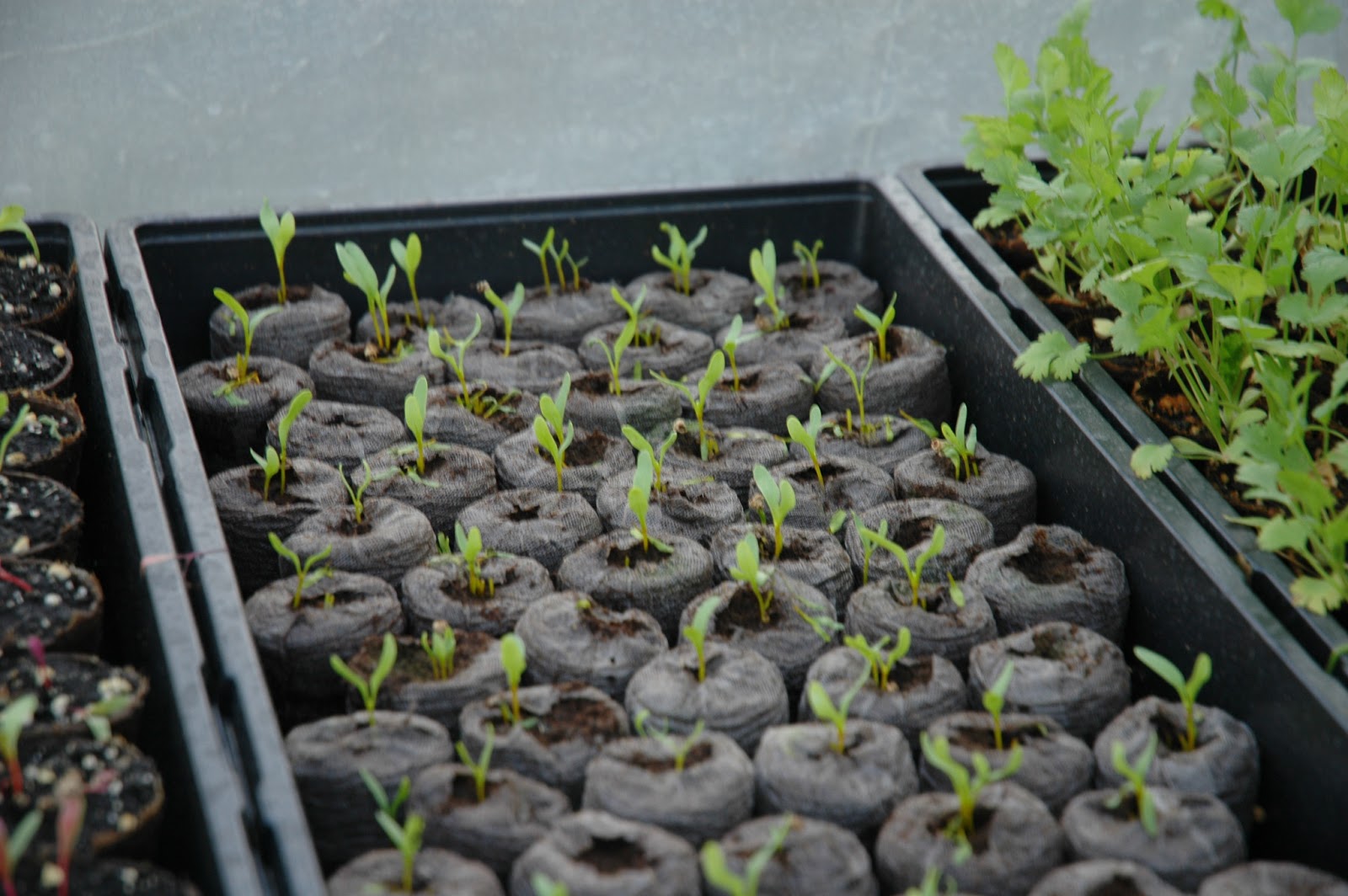
swiss chard and cilantro seedlings
  • Corbaci - 4
  • Coban - 2
  • Ashe County Pimento - 6
  • Tequila Sunrise - 3
  • Lipstick - 3
Hot Peppers
  • Fish - 3
  • Early Jalapeno - 1
  • Thai Red Pepper - 6
  • Serrano - 6
lettuce and beet seedlings
Tomatoes & Tomatillos
  • Rosso Sicilian - 3
  • Red Cherry - 4 
  • Cherokee Purple - 6
  • Green Velvet Tomato - 3
  • Arkansa Traveller - 3
  • Tess's Landrace - 6
  • Illini Star - 3
  • Plum Lemon - 6
  • Goldman's Italian American - 2
  • Verde Tomatillo - 5
  • Purple Tomatillo - 7
tomato plant
Eggplant
  • Thai Long Green - 6
  • Purple Pickling - 6
  • Ping Tung Long - 6
Greens
  • Bloomsdale Longstanding Spinach - 26
  • Red Russian Kale - 12
  • Da Ping Pu - 8
  • Tatsoi - 8
  • Arugula - 8
  • Gailaan - 8

December 19, 2012

Rice and Arsenic

Probably because I have a one year old and sometimes that's a little distracting, I completely missed this when it came out. Or I should say, I missed the gravity of it. I remember hearing there was something about arsenic in rice but I didn't realize what a big deal it was. 

While the FDA is characteristically cautious in their analysis, Consumer Reports advocates taking action, both personally and in terms of regulation, to deal with this problem. 

From the Consumer Reports study:
“We already know that high concentrations of arsenic in drinking water result in the highest known toxic substance disease risks from any environmental exposure,” says Allan Smith, M.D., Ph.D., a professor of epidemiology at the University of California, Berkeley. “So we should not be arguing to wait for years until we have results of epidemiologic studies at lower arsenic intake, such as from rice consumption, to take action.” 
"People who ate rice had arsenic levels that were 44 percent greater than those who had not, according to our analysis of federal health data."
I recommend reading their entire report.  

We're taking a better-safe-than-sorry approach and have stopped eating rice (except for arborio because a little rissotto now and then is a risk I'm willing to take and Poppyseed doesn't eat it anyway). We don't really need to eat rice and it's not a particularly nutritious grain anyway. Instead we're going with quinoa, couscous, millet, pollenta (oh dear lord do I love corn!), and bulgar. We already eat some of that some of the time. Last night was a mushroom and venison stew over Parmesan pollenta and in the summer we often eat tabbouleh. Couscous also makes regular summer appearances with tomatoes and feta. Millet is going to be a new one. I've eaten it before but never cooked it.


What are your favorite grains and favorite ways to eat them? After reading those reports, are you going to avoid rice?

April 3, 2012

Ruth Stout is Awesome

Lettuce growing in deep mulch in my garden.
11 years ago I read Ruth Stout's "No-Work Garden Book" and it changed my life (which is only a small exaggeration since gardening was 75% of my life). After reading that book I never tilled again (with two exceptions). I've been wanting to review her book for a while but I think this video might give you the idea. Basically she puts down a huge quantity of mulch which improves the soil, keeps weeds at bay, and prevents evaporation so she never weeds and never waters. I will say that growing in NY as she does is very different from growing in subtropical South Texas. Our weed pressure is tremendous for one thing. However, with some modifications, her method pretty much works for me: I pile up the mulch and sit back to watch things grow.

It never even occurred to me that a video of Ruth Stout existed and I'm so glad Sharon Astyk found one and posted it on one of her fantastic blogs.


Watch the video and check out one of Ruth Stout's books too. While you're at it take a look at Sharon Astyk's blogs Casaubon's Book and The Chatelaine's Keys (which in her words are all about "food, agriculture, energy issues and climate change") or one of her books. I've read and can recommend "Independence Days: A Guide to Sustainable Food Storage & Preservation".


September 6, 2011

Molt

Someone decided it was too damn hot...


 ... and that molting had to come early this year.

Notice the resemblance to a porcupine.

March 3, 2011

The To Do List

Spring is here in coastal Texas and that means tons to do. Does anyone else have this problem? Don't get me wrong, I loooove all this work and I feel very lucky I get to do it full time but this morning I made a list of all the things that need doing and found it very hard to know where to start.

 
Some big things have already been scratched off the list: the new chicken house got wheels and is now out in pasture (I'll do a post later about building the chicken house), the property got seeded with crimson clover and rye, seeds were started, fallow garden beds got amendments and fresh mulch and a lot of cleaning happened.

However...

To Do List, Spring 2011:

  • Fence lines need to be cleared
  • New fence to be installed
  • Old fences need some repair
  • Gates need repair

  • Build new beds in garden, planted with tomatoes, tomatillos, eggplant, hot peppers, ground cherry and cardboard mulched (every year the vegetable garden gets expanded)
  • Winter crops out of old beds, spring crops or cover crops in
  • Other vegetable beds need expanding and amending so I can plant corn, okra, winter squash, summer squash, and sweet peppers.
  • Still other old bed needs to be cardboarded and mulched again so I can plant gourds.
  • New trellis needs to be built and installed for cucumbers or beans
  • Herb transplants go in everywhere
  • More seeds need to be started

February 21, 2011

Rhizobia and Root Nodules

You know how people say that legumes "fix" nitrogen in the soil? Well here is how they do it:

Rhizobia!
Root nodules on vetch from my garden.

Rhizobia are a type of soil bacterium which infect and form a symbiotic relationship with legumes. Together they create little root nodules where they "fix" the nitrogen (N)... that is to say they take atmospheric N (straight out of the air) and turn it into a form usable by the plant. For this service the plant trades carbohydrates.  

February 16, 2011

Escaped Chickens

Those birdies are perched on the front gate between the area near our house where I have them temporarily and the front yard (note the protective dog in the back ground. Good girl Lily!).

Because their new house doesn't have wheels on it yet, I haven't moved them to the back half of the property where they'll rotate to new pasture every few days (note #2 - my very stupid dog has gotten immovably tangled in the pasture fence twice this month - the second time because she really wanted a piece of raw sweet potato I gave the birds).

February 15, 2011

Notes From the Kitchen and Garden

What I'm cooking...

  • Corned Beef no. 2 = in the pot for the next 5 days.
  • Homesick Texan's Sweet Potato Pie
  • Vegetable soup
  • Ginger cookies
  • Scrambled eggs! The babies haven't started laying yet but the retired girls... they're back in business! I think this is a temporary increase in lay (they've rested all winter) but since the days have been longer we've been getting 5-7 eggs most days, even when it doesn't get above freezing.
  • Beans


Tomato Seedlings


February 13, 2011

February 6, 2011

Seed Storage

For years I have been trying to come up with a method of seed storage that I like. I've tried bags, jars, boxes, seed starting trays stuffed with packets, and more but nothing worked for me. I have a whole lot of seeds so this has been a big pain.

Then a few weeks ago I read a post on seed storage by one of my favorite bloggers, Chiot's Run.

She solved my problem. I'm clearly an idiot for not thinking of this myself :-)

January 28, 2011

Today's Seeds Started

Today was a big seed starting day. Second round of Solanaceae and first round of many other things. Here's what got seeded:

Tomatoes
Red Cherry, 6
Arkansas Traveler, 6
Seeds in the greenhouse a few years ago.
Green Velvet, 6
Rosso Siciliano, 6
Plum Lemon, 6
Cherokee Purple, 6

Greens and Lettuce
Tatsoi, 12
Marvel of 4 seasons, 16
Gailan Queen, 8
Da Ping Pu, 8
Jericho, 6

January 22, 2011

Spring Greens

Sometimes in spring (or late winter which is kind of early spring here) the fresh growth looks so good and juicy I want to eat it. Seriously, I am tempted.

Lucky duck (Or chicken, as the case may be). She gets to munch it all day long.

Yum yum yum.


Oh! She's on to me! She knows I covet her grass.


And now she's ignoring me. Maybe I can sneak some grass while she's not looking...